The Sussex spinout says it is the largest Series A ever raised by a UK-headquartered quantum company.
Universal Quantum, the University of Sussex spinout building trapped-ion quantum computers, has raised more than $100m (about £75m) in a Series A round co-led by Silicon Valley investor DCVC and quantum specialist Firgun Ventures. The company didn’t disclose a valuation.
The business designs quantum computers that use charged atoms, or ions, held on silicon chips to carry out calculations. Its pitch is modularity. Instead of building one enormous processor, it links many small chips together using its own patented interconnect, an approach it says avoids the photonic links, large lasers and heavy cooling equipment that rival designs depend on.
The money will go on developing and commercialising that architecture, including the chip arrays and control systems, and on international expansion. Universal Quantum is setting up a research and development centre in Singapore, its first outside Europe, and plans to grow in the US, Japan and at its German hub in Hamburg.
The investor list is long and unusually international. Singapore’s state-backed EDBI joined the round, as did Artal (advised by Invus), Integral GlobalTech, Main Sequence, Hostplus, NGS Super, IAG Capital, EdenBase, Eigenstate Holdings, SiteGround Capital and Roblox founder Dave Baszucki. Nauta Capital and The Venture Collective also took part. Lazard advised the company.
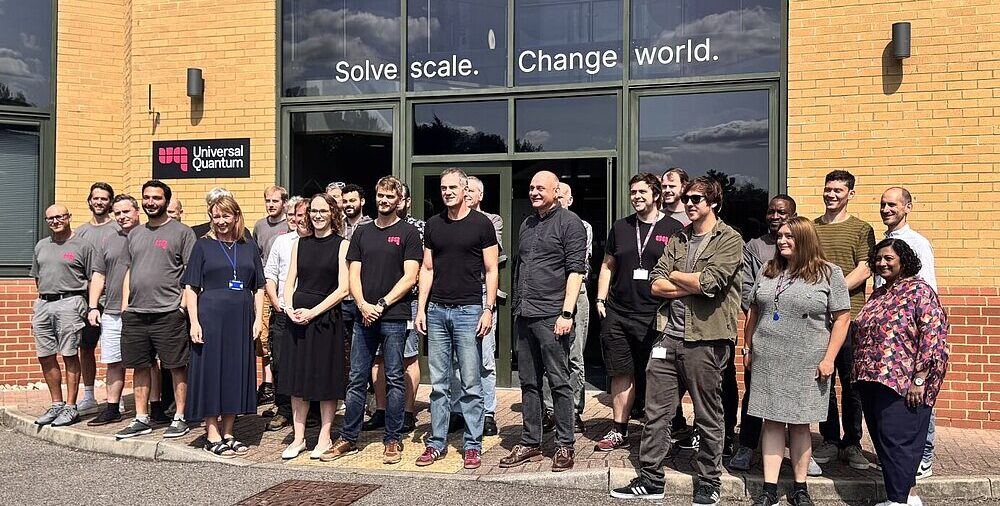
Universal Quantum was founded in 2018 by Sebastian Weidt, its chief executive, and Winfried Hensinger, both professors at Sussex, and is based in Haywards Heath. Its best-known commercial win is a contract with the German Aerospace Center (DLR) to build quantum computers in Hamburg, announced in 2022 at €67m and now valued by the company at $77m. It describes this week’s round as the largest Series A raised by a UK-headquartered quantum firm, a claim that is the company’s own.
James Hardiman, general partner at DCVC, said:
“True quantum utility will be unlocked by companies that are relentlessly focused on the scalability of their machines.”
Weidt added:
“This round unites an extraordinary group of investors from the world’s most important pools of capital around a single mission: delivering utility-scale quantum computing.”
One of the company’s own backers supplied the note of caution. Bill Bartee, managing partner at Main Sequence, described quantum as a sector where “hype and hyperbole are running far ahead of commercial reality”, and said Universal Quantum stood out for winning major contracts at this stage.
That is a fair summary of what investors are buying. The announcement leans on contracts and capital, and came without qubit counts or error rates, the numbers by which quantum hardware is normally judged. British trapped-ion rival Oxford Ionics was bought by US group IonQ in a $1.075bn deal agreed last year. Universal Quantum now has the money to stay independent for a good while longer, and delivery in Hamburg will be the first public test of whether the modular approach works.